Cartagena
Caribbean · heritage · tourism-driven
About Cartagena
A UNESCO heritage city and one of Colombia's most visited destinations: Bocagrande, Castillogrande and the Centro concentrate premium supply and short-term rentals. Tierra Bomba, minutes away by boat, adds beach clubs and boutique hotels, with utility and title caveats.
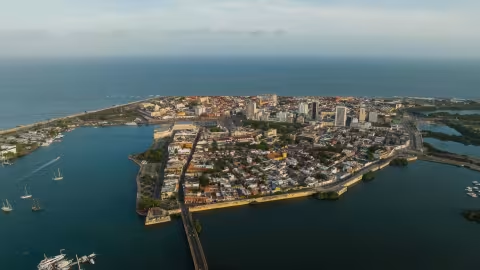
Cartagena de Indias, capital of Bolívar and a UNESCO World Heritage city, is one of Colombia's most tourism-driven real estate markets: its airport handled a record 7.7 million passengers in 2025, and the city draws cruise ships, conventions and events year-round. Premium supply is concentrated on the Bocagrande peninsula — Bocagrande, Castillogrande and El Laguito — in the walled Centro Histórico and Getsemaní, and along the coastal corridor of Crespo, Marbella and the Zona Norte, where Serena del Mar is growing as a planned city; Manga, on the bay, keeps a more residential, traditional profile. According to the Catastro Cartagena Real Estate Observatory, Bocagrande posts the highest asking prices on the coastal strip, followed by Castillogrande and Serena del Mar, with El Laguito, El Cabrero, Marbella and Crespo one step below. Short-term rentals are the main investment driver, but they require building bylaws (reglamento de propiedad horizontal) that expressly allow tourist rentals and an operator registered in the Registro Nacional de Turismo (RNT), mandatory for stays under 30 days. In the Centro Histórico, any work on heritage properties needs approval from the heritage authorities in addition to a building permit.
Tierra Bomba
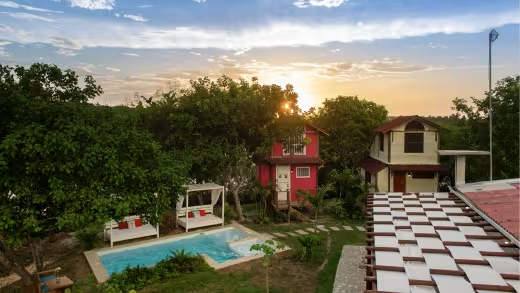
Tierra Bomba is an island of about 20 km² inside the bay, facing Bocagrande and Castillogrande. It is a 10–20 minute boat ride from the landing behind the Nuevo Hospital Bocagrande or from the Muelle de La Bodeguita in the Centro; the crossing to Bocachica takes about 25 minutes. It is home to four communities of Afro-Colombian heritage — Tierra Bomba, Punta Arena, Bocachica and Caño del Oro: Punta Arena concentrates the beach clubs and boutique hotels with views of the city skyline, while Bocachica holds the Fuerte de San Fernando and the Batería del Ángel San Rafael, which guard the entrance to the bay. Investors should note important caveats: the island has no water mains or sewerage (water arrives by tanker truck or is bought bottled, and the aqueduct project is still pending), power service suffers outages, and all logistics depend on sea transport. Land tenure is also complex: the Navy claims part of the land as state property, community councils have applied for collective titling, and beaches and tidal land are public-use assets that can only be occupied under a Dimar concession. Before any deal, a rigorous title study is essential, including the property registration record (folio de matrícula inmobiliaria) and verification with the Agencia Nacional de Tierras.
Mobility and transport
Rafael Núñez International Airport, in Crespo, is about 20–30 minutes from Bocagrande, with domestic flights and direct routes to the United States, Panama, Peru and Spain. Transcaribe, the bus rapid transit system, links Bocagrande with the Centro and Avenida Pedro de Heredia, complemented by taxis and ride-hailing apps. Bocagrande, the Centro Histórico and Getsemaní are flat and walkable; the Zona Norte and Serena del Mar depend on a car via the Vía al Mar. Tierra Bomba and the islands are reachable only by sea, on public boats with no fixed schedule or private boats from docks and marinas: agree on the fare and return time before boarding.
Safety
Safety perception is a point to watch: in Cartagena Cómo Vamos' 2025 Citizen Perception Survey, 53% of residents said they feel unsafe in the city, and street robbery tops the problems they report in their neighborhoods. The picture is more favorable in tourist and upper-stratum sectors — one in two higher-income residents feels safe in their immediate surroundings — with buildings offering 24-hour concierge, CCTV and private security, and Tourism Police present in the busiest areas. The usual caution applies on beaches and at night, and it is wise to agree on prices upfront with informal vendors and boat operators.
Retail and services
Avenida San Martín, in Bocagrande, concentrates hotels, restaurants, banks and supermarkets, alongside Plaza Bocagrande Mall. Caribe Plaza, in Pie de la Popa, and Mall Plaza El Castillo are the city's large malls, with anchor stores, supermarkets and cinemas; in the Centro, La Serrezuela occupies the restored former circus-theater. The Centro Histórico and Getsemaní hold the most acclaimed dining scene on Colombia's Caribbean coast, and the Zona Norte adds retail and services along the Vía al Mar and in Serena del Mar.
Education and universities
The best-known bilingual schools are in the Zona Norte, along the Anillo Vial: Colegio Jorge Washington, with a US curriculum, and Colegio Británico de Cartagena. In higher education, the standouts are the public Universidad de Cartagena, with its historic seat in the Centro; Universidad Tecnológica de Bolívar, with a site in Manga and a campus in Ternera; and the local branches of Universidad Jorge Tadeo Lozano and Universidad del Sinú.
Healthcare
Nuevo Hospital Bocagrande, in Castillogrande, provides medium- and high-complexity care with an ICU and sits next to the boat landing for Tierra Bomba; Clínica Medihelp operates in the same area. In the Zona Norte, Hospital Serena del Mar, run by the Fundación Santa Fe de Bogotá and accredited by the Joint Commission International, was named the best hospital in the Caribbean region by Newsweek in 2024. Health services on the island are basic, so emergencies and specialists mean crossing the bay.