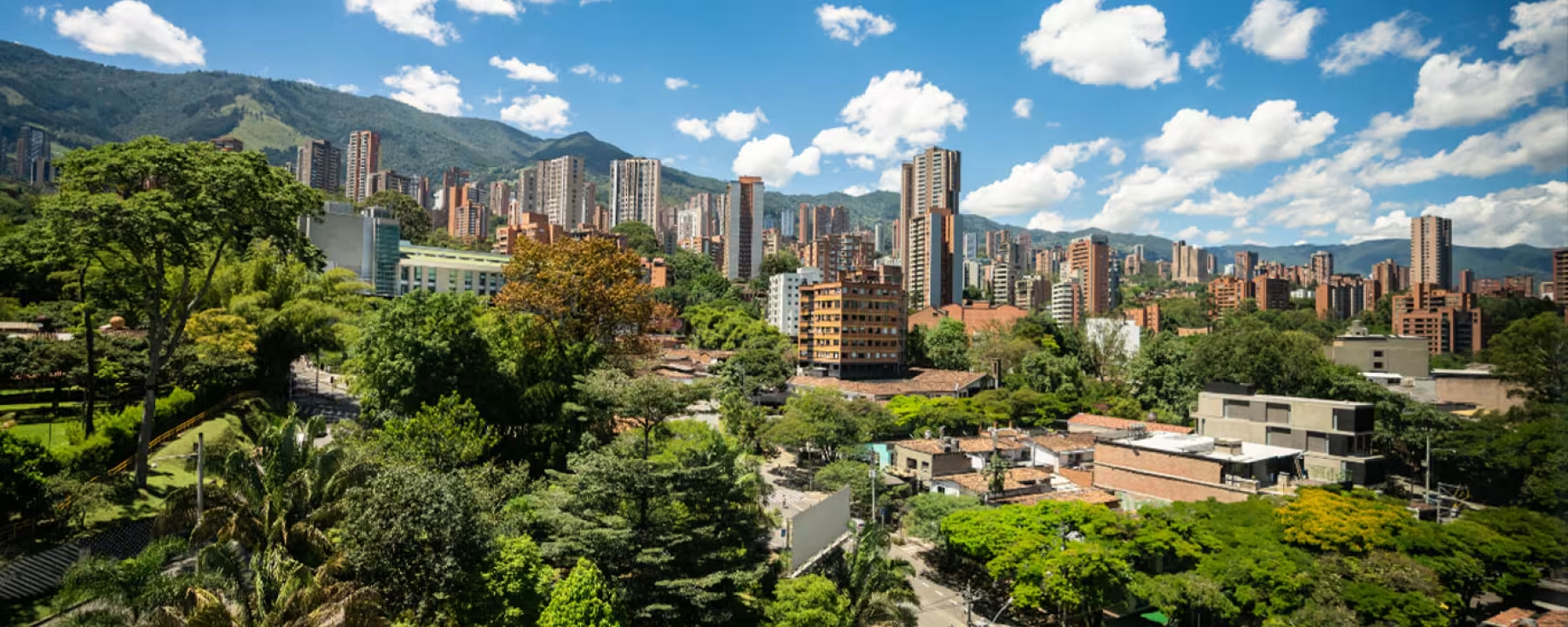
In the plenary session that began on November 4, 2026, Medellín's City Council (Concejo) approved Bill 104 of 2026 (Proyecto de Acuerdo 104 de 2026) with 18 votes; the Council's bill-tracking system, SIMI, records the approval on November 5. The bill is the mid-term revision of the POT (Plan de Ordenamiento Territorial, the city's land-use and zoning plan) and the update of its hazard and risk rules. According to the Mayor's Office (Alcaldía), it has 757 articles on housing, transportation, land use, tourist rentals (vivienda turística), risk and rural land. It applies only in Medellín.
Two things are worth being clear about from the start. First, approved is not the same as in force. As of this publication, November 2026, the mayor has not signed the ordinance (the step called sanción) and it has not been published in the District's official gazette, the Gaceta Oficial. SIMI still lists the bill as "Approved in second debate" (Aprobado en segundo debate), and the gazette does not include it: the latest edition we checked is no. 5983, dated November 12. That is why the ordinance (acuerdo) has no number and no final official maps yet, and the rule in force is still Acuerdo 48 de 2014, the 2014 POT. We will update this article when the ordinance is signed.
Second, the POT does not say what your apartment will be worth. It says what can be built, what activity can operate and what restrictions apply to each property. Here we explain it with the official sources and the date of each fact.
What is the POT and what is it for?
The POT is the rule that decides how land is used in a municipality: what can be built and how tall, which activities fit in each zone, which areas are protected and which carry risk. Law 388 of 1997 requires it. Under its article 9, municipalities with more than 100,000 inhabitants adopt a POT; those with 30,000 to 100,000, a Basic Plan (PBOT); and smaller ones, a Scheme (EOT). The name changes with population, not with importance.
For anyone buying, selling or investing, the POT answers three questions about a specific property:
- What can be built? Height, density, building ratios and planning obligations (what a project must contribute in public space and community facilities).
- What can operate there? Housing, retail, offices, lodging or industry, depending on the zone's level of mixed use.
- What limits it? Hazard and risk, setbacks from streams, environmental protection areas and rural land.
In Medellín, the rule in force is Acuerdo 48 de 2014, and it will stay that way until the revision is signed and published. When the Council received the revision on August 19, 2026, its president noted that the plan had gone "more than 12 years" without a revision.
What did the City Council approve in November 2026?
The Council approved Bill 104 of 2026 in second debate, the plenary vote. It combines two things: the mid-term revision of the POT and the exceptional amendment of the hazard and risk rules. The vote was 18 in favor; the local outlet Minuto30 also reported 2 votes against and 1 abstention. According to the coordinator of the bill's rapporteurs, councilor Andrés Tobón, 78% of the articles discussed were amended during its passage through the Council.
The approved text is not public yet. SIMI holds the bill as filed, the report for the second debate (October 29, 2026) and the amendments, but not the final version. That is why this article describes the revision as the Mayor's Office, the city's Planning Department (Planeación) and the Council explained it, with the date of each explanation; we do not quote the final text.
| Date | What happened | Source |
|---|---|---|
| June 2, 2026 | The District and the Metropolitan Area sign the agreement on the environmental and metropolitan planning requirements, after nine technical sessions | Mayor's Office of Medellín, June 3, 2026 |
| August 19, 2026 | The Mayor's Office files the bill with the Council: about 17,000 pages | Medellín City Council, August 19, 2026 |
| August 25, 2026 | The Mayor's Office publishes two lookup tools: Consulta Normativa and the Laboratorio de Consultas POT | Mayor's Office of Medellín, August 25, 2026 |
| October 26, 2026 | The Planning Department explains the update of the hazard and risk maps | Mayor's Office of Medellín, October 26, 2026 |
| November 4 and 5, 2026 | Approval in second debate with 18 votes; SIMI records the approval on November 5 | Medellín City Council, November 4, 2026; SIMI |
| November 5 and 11, 2026 | The Mayor's Office reports the approval of 757 articles and publishes a summary of the changes | Mayor's Office of Medellín, November 5 and 11, 2026 |
| November 17, 2026 | No signature on record: SIMI still lists the bill as "Approved in second debate" and the Gaceta Oficial has not published it (latest edition checked: no. 5983, of November 12) | SIMI and Gaceta Oficial, checked on November 17, 2026 |
| Pending | The mayor's signature, the ordinance number and publication in the Gaceta Oficial | We will update this row when it happens |
According to the Mayor's Office, the process included more than 230 meetings, more than 10,000 attendances and 8,155 citizen contributions; 6 in 10 were taken up in full or in part (statement of November 5, 2026).
Is the new POT already in force?
No. As of this publication, November 2026, the ordinance has not been signed or published. Law 136 of 1994 sets out the remaining steps: a bill approved in second debate goes to the mayor within the following five business days for signature; the mayor has up to 20 days to return it with objections when the bill has more than 50 articles; and the signed ordinance must be published within the following 10 days (articles 76, 78 and 81). In addition, a general administrative act is not binding until it is published in the gazette (Law 1437 of 2011, article 65). In the meantime, the rule in force is Acuerdo 48 de 2014. We will update this article when the ordinance is signed.
This matters for a practical reason. The Mayor's Office tool Consulta Normativa compares Acuerdo 48 de 2014 with the proposed revision, and it was published while the text was still a bill. Once the ordinance is signed, it is worth checking each property again against the final version.
If you have already filed for a license or run a business
For licenses, the rule is national. If the planning rules change between the application and the issuance of a license, whoever filed the application properly and in full (en legal y debida forma) is entitled to have the license granted under the rules in force on the filing date (Decreto 1077 de 2015, article 2.2.6.1.2.1.2, paragraph).
For activities already operating, the city's Tourism Department (Secretaría de Turismo) explained on November 3, 2026 that the bill (article 331) recognizes "established uses" (usos establecidos): those set up in line with the rules in force when they were located, that have operated continuously and that run in a building meeting the planning and construction conditions, or that are going through recognition. According to the same department, since low mixed-use zones (baja mixtura) have not allowed lodging since 2014, a tourist rental set up there after that is not covered. This is a provision of the bill: its number and wording may change in the signed text. If the ordinance brings its own transition rules, we will explain them when it is published.
This is general information, not legal advice. If you have a license in process or an activity in operation, review your case with a lawyer.
What changes? The seven topics that matter most to buyers
Until the ordinance is published, what can be reported is what the Mayor's Office, the Planning Department and the Council explained about the revision. Each row carries its source and date; the signed text may adjust the details.
| Topic | What the official source explained | What it means for a buyer |
|---|---|---|
| Housing | Incentives for social-interest (VIS) and priority (VIP) housing, recognition of collective housing and adjustments to building conditions (Mayor's Office, November 11, 2026) | In the debate, councilor Santiago Narváez spoke of 49 zones (polígonos) with potential for 83,500 homes (November 4, 2026). That is regulatory capacity, not projects under construction |
| Transit-oriented development (DOT) | Provisions on parking and buildability tied to public transportation and to the features of each area (Mayor's Office, November 11, 2026) | Being near the Metro does not, by itself, increase what can be built on a lot; it depends on the property's own zoning sheet |
| Urban renewal | Stronger guidelines to revitalize areas, linked to risk management (Mayor's Office, November 11, 2026). According to the Planning Department, the bill has three modes: redevelopment, reactivation and revitalization (Council, October 1, 2026) | According to the Planning Department, under the bill the reactivation and revitalization modes allow projects to go ahead lot by lot, without a partial plan (plan parcial, a planning instrument for a larger area) (Council, October 1, 2026). This still has to be confirmed in the signed ordinance |
| Land use and coexistence | Adjusted rules for economic activities and their impacts: noise, odors and air quality (Mayor's Office, November 5, 2026) | A "well-located" storefront is not the same as a permitted use. According to rapporteur Andrés Tobón (Council, November 4, 2026), new nightlife venues will only be able to open where nightlife already exists |
| Tourist rentals (vivienda turística) | According to the Tourism Department, the bill keeps the restriction in low mixed-use zones, in place since 2014; promotes tourist rentals in high mixed-use zones and around transportation; and regulates them in medium mixed-use zones (November 3, 2026). The Mayor's Office confirmed that the approved text adjusts the conditions for tourist rentals, without giving details (November 5, 2026) | We explain it in detail in Airbnb in Medellín under the new POT |
| Hazard and risk | Under the bill, areas with a risk condition go from 610 to 1,610 hectares, based on studies by Universidad EAFIT (Planning Department, October 26, 2026) | "Risk condition" does not mean "uninhabitable": it marks areas that require detailed studies |
| Environment and rural land | Protection of the ecological structure, streams and green areas; rural uses in line with the environmental requirements and the permanence of farming communities (Mayor's Office, November 11, 2026) | In the five rural districts (corregimientos), a lot or a farm is reviewed under rural rules, not urban ones |
There is an eighth topic that is easy to misread: community facilities (equipamientos). According to the Planning Department, the proposal allows a school or a cultural center to combine its use with retail and services: in general terms, 70% of the built area keeps its community-facility use and 30% may have other uses (November 3, 2026). That rule is for community facilities, not for a home to set aside 30% for retail. Also, the difference between the 2,139 facilities in the 2014 database and the 2,312 records of 2026 does not mean 173 new facilities: according to the Planning Department, it reflects more precise mapping.
What does not change?
- The lodging restriction in low mixed-use zones. Since Acuerdo 48 de 2014 (article 255), no type of lodging is allowed in those zones, hotels included. According to the Tourism Department, the revision does not create that restriction: it keeps it (November 3, 2026).
- Established activities that comply with the rules. In the debate, the Planning Department said that the conditions for established economic activities are not changing and that the ordinance recognizes those that already comply with the regulations (Council, November 4, 2026).
- The rules of neighboring municipalities. Envigado, Sabaneta, Itagüí and Bello have their own POT or PBOT. The Metropolitan Area (Área Metropolitana del Valle de Aburrá) coordinates the whole with its Metropolitan Strategic Land-Use Plan (PEMOT) 2019-2032, but it does not replace each municipality's rules. We go into detail in how the new POT affects your investment.
- The value of your property. No official source attributes a zone-by-zone increase in value to the POT, and we do not project one either.
How do I check the POT for a property in Medellín?
There are three public lookup tools, and it helps to use them in this order:
- Consulta Normativa, from the Mayor's Office. It lets you look up the rules by property, address, cadastral code or from the map, and compare Acuerdo 48 de 2014 with the revision. There you see whether a property is in a low, medium or high mixed-use zone.
- MapGIS. The District's long-standing geoportal, with layers of the POT in force. Before reading a layer, check its date.
- Laboratorio de Consultas POT. An artificial-intelligence chat about the revision's technical documents. It helps you understand a concept, not certify a property's rules.
Looking for Medellín's POT as a PDF? Acuerdo 48 de 2014, the rule in force, can be downloaded as it was published in Gaceta Oficial 4267. The documents of Bill 104 of 2026, about 17,000 pages, are in the Council's Sistema de Información Misional (SIMI): the bill as filed, the report for the second debate and the amendments. The text approved in November 2026 has not been published yet; we will link it here when it is.
The formal concept: zoning rules or land use
If you are going to buy, build or open a business, keep the online lookup, but do not rely on it alone. In Medellín you can ask an urban curator's office (curaduría urbana, the office that issues building licenses) for a concepto de norma urbanística, which says which planning rules apply to the property, or a concepto de uso del suelo, which says which uses are allowed on the property or in the building. National rules give 15 business days to respond, counted from the day after filing, and set a fee of 8.34 UVT and 1.67 UVT, respectively. The UVT (Unidad de Valor Tributario) is a value unit that DIAN, Colombia's tax authority, sets each year; at the 2026 UVT of COP 52,374, that is about COP 436,800 and COP 87,500 (Decreto 1077 de 2015, articles 2.2.6.1.3.1 and 2.2.6.6.8.15; DIAN Resolution 000238 of 2025). Confirm the final amount when you file.
The Mayor's Office also issues a land-use concept online for economic activities through its Consulta Uso Suelo tool in MapGIS: you search for the property by address, property registration number (matrícula) or CBML code, choose up to three activities and download the concept as a PDF. Today it works on the basis of Acuerdo 48 de 2014. None of these concepts grants rights or creates obligations: for a purchase, what counts is the property's license. Keep a screenshot or the PDF of each lookup with its date: if the rules change, it is your record of what you saw.
A word of caution about the maps circulating on social media. A "new POT" map without a source, an official legend or a date is not regulatory mapping, however professional it looks. The official zones are the District's, and the final ones will come with the signed ordinance.
What this means if you are buying in Medellín
If you will live in the property, the POT rarely changes your decision. It can help you understand the surroundings: for example, whether the street is in a medium or high mixed-use zone and may fill up with businesses, or whether there is a transportation corridor where more will be built. If you are buying to invest, the POT weighs much more. It determines whether an apartment can operate as a short-term rental and whether a lot has the potential the listing promises. It also tells you whether the property ended up in a zone that requires risk studies.
In Compra Clara, our guided buying process, this is step 03, "Verify" (Verifica). Before an offer, we review the property's zoning rules, the condominium bylaws (reglamento de propiedad horizontal) and the licenses, so that the decision does not depend on a news story or an unsourced map. You can see what we have today in properties in Medellín, read what it is like to live in Laureles or talk to an advisor.
Sources
Checked on November 17, 2026. The Gaceta Oficial and the Mayor's Office press room were checked again on November 18, 2026, with no changes. Titles stay in Spanish, with a short English gloss.
- Medellín City Council, Sistema de Información Misional (SIMI), Proyecto de Acuerdo 104 de 2026 (Bill 104 of 2026), "Estados" and "Archivos" tabs, checked on November 17, 2026. Supports: "Aprobado en segundo debate" dated November 5, 2026, with no later status; the documents available (bill as filed, report for the second debate of October 29, 2026, and amendments), with no final text. https://simi.concejodemedellin.gov.co/simi3/invitados/proyectos/proyect…
- Medellín City Council, SIMI, list of acuerdos (ordinances), checked on November 17, 2026. Supports: no recorded ordinance comes from Bill 104 of 2026. https://simi.concejodemedellin.gov.co/simi3/invitados/proyectos/acuerdo…
- Gaceta Oficial del Distrito de Medellín (official gazette), public search, checked on November 17 and 18, 2026. Supports: the latest edition is no. 5983, of November 12, 2026, and it does not contain the ordinance. https://www.medellin.gov.co/statements/innovaciondigital/gacetas/consul…
- Concejo de Medellín, «Medellín revisa y ajusta su Plan de Ordenamiento Territorial…» (Medellín reviews and adjusts its POT), November 4, 2026. Supports: approval of Bill 104 of 2026 with 18 votes in the plenary that began on November 4, amendment of 78% of the articles, 49 zones and 83,500 potential homes, nightlife, tourist rentals and established activities. https://www.concejodemedellin.gov.co/blog/2026/11/04/medellin-revisa-y-…
- Concejo de Medellín, «Vivienda, renovación urbana y nuevos modelos de gestión, en el avance de la revisión del POT» (housing, urban renewal and new management models), October 1, 2026. Supports: the bill's three urban renewal modes and lot-by-lot development, without a partial plan, in reactivation and revitalization. https://www.concejodemedellin.gov.co/blog/2026/10/01/vivienda-renovacio…
- Alcaldía de Medellín, «El Concejo de Medellín aprobó el proyecto de acuerdo para la revisión del POT» (the Council approved the POT revision bill), November 5, 2026. Supports: 757 articles, topics approved, adjustment of the conditions for tourist rentals and participation figures. https://www.medellin.gov.co/es/sala-de-prensa/noticias/el-concejo-de-me…
- Alcaldía de Medellín, «Medellín aprueba la revisión del POT para acercar la vivienda al transporte…» (bringing housing closer to transportation), November 11, 2026. Supports: DOT, housing, renewal, rural land and environment. https://www.medellin.gov.co/es/sala-de-prensa/noticias/medellin-aprueba…
- Minuto30, «Concejo de Medellín aprobó el POT en segundo debate con 18 votos a favor» (the Council approved the POT with 18 votes), November 5, 2026, with information from Caracol Radio. Supports: votes against and abstention. https://minuto30.com/concejo-de-medellin-aprobo-el-pot-en-segundo-debat…
- Secretaría de Turismo y Entretenimiento (Tourism Department), «Vivienda turística y POT: dónde sí, dónde no y con qué reglas» (tourist rentals and the POT: where, where not and under what rules), November 3, 2026. Supports: restriction in low mixed-use zones since Acuerdo 48 de 2014 (article 255), proposal for medium and high mixed-use zones and the bill's "established uses" (article 331). https://www.medellin.gov.co/es/sala-de-prensa/noticias/vivienda-turisti…
- Departamento Administrativo de Planeación (Planning Department), update of the hazard and risk maps, October 26, 2026. Supports: areas with a risk condition from 610 to 1,610 hectares. https://www.medellin.gov.co/es/sala-de-prensa/noticias/la-alcaldia-de-m…
- Departamento Administrativo de Planeación, community facilities, November 3, 2026. Supports: the 70/30 mix and the 2,139 versus 2,312 mapping records. https://www.medellin.gov.co/es/sala-de-prensa/noticias/el-pot-de-medell…
- Departamento Administrativo de Planeación, lookup tools, August 25, 2026. Supports: Consulta Normativa and Laboratorio de Consultas POT. https://www.medellin.gov.co/es/sala-de-prensa/noticias/dos-nuevos-aplic…
- Concejo de Medellín, filing of the bill, August 19, 2026. Supports: filing date, 17,000 pages and "more than 12 years" without a revision. https://www.concejodemedellin.gov.co/blog/2026/08/19/se-radico-en-el-co…
- Alcaldía de Medellín, agreement with the Metropolitan Area, June 3, 2026. Supports: the June 2 agreement and nine technical sessions. https://www.medellin.gov.co/es/?p=536543
- Alcaldía de Medellín, POT page and Gaceta Oficial 4267 (Acuerdo 48 de 2014). Supports: download of the ordinance in force. https://www.medellin.gov.co/es/transparencia/plan-de-ordenamiento-terri… and https://www.medellin.gov.co/es/wp-content/uploads/2022/10/Gaceta-4267-A…
- Alcaldía de Medellín, Consulta Uso Suelo Acuerdo 048 (MapGIS land-use lookup). Supports: online land-use concept based on Acuerdo 48 de 2014. https://www.medellin.gov.co/mapgis9/tools/UsoSuelos.html
- Ley 388 de 1997 (Law 388 of 1997), article 9. Supports: types of plan (POT, PBOT, EOT) by population.
- Ley 136 de 1994 (Law 136 of 1994), articles 76, 78 and 81. Supports: deadlines for signing, objecting to and publishing ordinances; Ley 1617 de 2013 (article 2) refers districts to that regime for what it does not regulate. http://www.secretariasenado.gov.co/senado/basedoc/ley_0136_1994_pr001.h… and http://www.secretariasenado.gov.co/senado/basedoc/ley_1617_2013.html
- Ley 1437 de 2011 (Law 1437 of 2011), article 65, as amended by Ley 2080 de 2021. Supports: general acts are not binding until published. http://www.secretariasenado.gov.co/senado/basedoc/ley_1437_2011_pr001.h…
- Decreto 1077 de 2015 (Decree 1077 of 2015), articles 2.2.6.1.2.1.2, 2.2.6.1.3.1 and 2.2.6.6.8.15 (Función Pública compilation). Supports: rules that apply to licenses already filed; zoning-rules and land-use concepts, who issues them, the 15-business-day deadline and the fees of 8.34 and 1.67 UVT. https://www.funcionpublica.gov.co/eva/gestornormativo/norma.php?i=77216
- DIAN, Resolución 000238 de 2025 (DIAN Resolution 000238 of 2025). Supports: the 2026 UVT, COP 52,374. https://normograma.dian.gov.co/dian/compilacion/docs/resolucion_dian_02…
- Área Metropolitana del Valle de Aburrá, Subdirección de Planeación (Metropolitan Area planning office). Supports: PEMOT 2019-2032. https://www.metropol.gov.co/area-metropolitana/Pages/Planeacion/conoce-…
- Alcaldía de Itagüí, POT microsite (Acuerdo 09 of December 5, 2023). https://itagui.gov.co/micrositios/micrositio/POT
- Alcaldía de Sabaneta, participatory assessment of the POT, February 23, 2026. https://sabaneta.gov.co/noticias/sector-transporte-una-invitacion-a-que…
What people ask us most
Plan de Ordenamiento Territorial, the land-use and zoning plan. It is the municipal rule that sets land uses, what can be built, protected areas and risk zones. In Colombia it is governed by Law 388 of 1997; mid-sized municipalities adopt a PBOT and small ones an EOT.
When the mayor signs the ordinance and it is published in the District's Gaceta Oficial. The Council approved it in the plenary session that began on November 4, 2026 (SIMI records the approval on November 5); as of this publication, November 2026, there is no record of the signature. Until then, the rule in force is Acuerdo 48 de 2014. We will update this answer when the ordinance is signed.
Under national rules, if the planning rules change between the application and the issuance, you are entitled to have the license granted under the rules in force on the filing date, as long as you filed it properly and in full (Decreto 1077 de 2015, article 2.2.6.1.2.1.2). If the ordinance brings its own transition rules, we will explain them when it is published. This is general information, not legal advice: review your case with a lawyer.
Start with Consulta Normativa. If you are going to buy, build or open a business, ask an urban curator's office (curaduría urbana) for a zoning-rules concept or a land-use concept: national rules give 15 business days to respond and set a fee of 8.34 UVT or 1.67 UVT (about COP 436,800 or COP 87,500 in 2026). Neither grants rights, and both report on the rules in force, which today are Acuerdo 48 de 2014.
No official source says so. The POT changes what can be built and used on each property; the price also depends on the market, supply and the condition of the property. Be wary of anyone who promises an increase in value because of the POT.
In the Mayor's Office tool Consulta Normativa, which compares the 2014 rules with the 2026 revision, and in the MapGIS geoportal. Check the date of each layer. The final official maps will come with the signed ordinance: check again when it is published.
No. Each municipality in the Aburrá Valley has its own POT or PBOT. For example, Itagüí adopted its plan with Acuerdo 09 de 2023, and Sabaneta opened the participatory assessment for its revision in 2026.

CTO at Propiedades Luxur. After more than 15 years building accessible web platforms — over 30, for organizations in finance, healthcare and technology — John now leads the site, the data and the tools behind every purchase we guide in Medellín, and writes Insights so the rules, the figures and the timelines read without fine print.
Ready to work out the full cost of your purchase?
Tell us what you are looking for. We put together the real budget, closing costs included, before you make an offer.
Where can you run an Airbnb in Medellín under the new POT? How to check an apartment before you buy
Short-term rentals in Medellín depend on land-use mix, license, condo bylaws and the RNT, new POT included. How to check an apartment before you buy.
How does the new POT affect your real estate investment in Medellín and the Aburrá Valley?
Medellín's new POT does not guarantee appreciation: it will change what can be built and used on each lot. Six effects and what to check before investing.