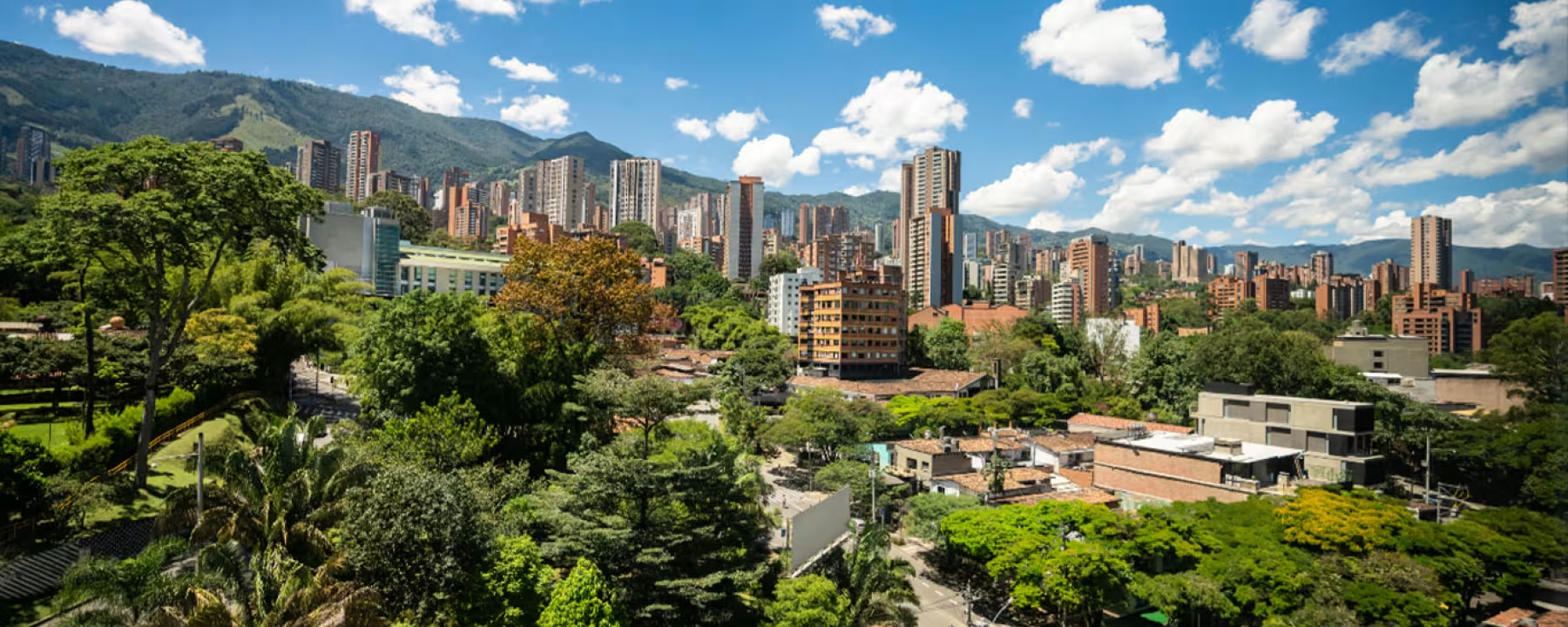
The revision of Medellín's POT does not guarantee that any area will gain value. It changes what can be built and what activity can operate on each lot. For an investor, it moves six things: short-term rentals, new construction near transit, urban renewal, risk, commercial uses and rural land.
The POT (Plan de Ordenamiento Territorial) is the city's land-use and zoning plan. The Concejo, Medellín's city council, approved the revision in the plenary session that began on 4 November 2026; the SIMI, the council's bill-tracking system, records the approval on the 5th. But it is not in force yet. As of 17 November 2026, the mayor had not signed it into law (the step called sanción) and it had not been published in the Gaceta Oficial, the city's official gazette. The rules in force are still those of Acuerdo 48 de 2014, the city ordinance that adopted the 2014 POT. And once the revision takes effect, it will apply only in Medellín. That matters in a metropolitan area where the borders are invisible: one street in Medellín and the next, already in Envigado or Itagüí, can have very different rules.
Below we go through each effect with its official source and its date, and we end with a checklist for any investment purchase. You will not find appreciation percentages here: no official source gives them, and we do not project them. We will update this article when the Acuerdo is signed.
First: the POT is not a price forecast
The POT is a land-use rule. It decides what can be built, how high and with what obligations, which activities fit in each zone and which areas carry restrictions. A property's price depends on that, but also on supply, demand, interest rates and the condition of the building. If someone shows you a map of "higher-potential zones" under the new POT, ask where those polygons come from. The official ones are the city's, and their final version will not be known until the mayor signs the Acuerdo and it is published in the Gaceta Oficial: as of 17 November 2026, neither had happened. If this is your first read on the subject, start with what Medellín's POT is and what changes.
Approved is not the same as in force. Under Ley 136 de 1994, Colombia's law on municipal government, the mayor has up to 20 days to object to a bill of more than 50 articles, and once signed, the Acuerdo must be published within the following 10 days (articles 78 and 81). A general administrative act is not binding until it is published in the gazette (Ley 1437 de 2011, article 65). And if a building permit application was filed complete and in due form, national rules give the right to have it decided under the rules in force on the filing date (Decreto 1077 de 2015, article 2.2.6.1.2.1.2). That is what the law says in general. If your investment depends on a permit in process, or on the date the revision takes effect, review your case with a lawyer.
Six effects of the new POT on an investment
The approved text is not public: neither the Gaceta Oficial nor the SIMI has the final version yet. So what follows describes the bill as the city government (Alcaldía), its Planning Department (Planeación) and the Concejo explained it, with the date of each explanation. The signed Acuerdo may refine it.
| Effect | What the official source says about the bill | What to check on the lot |
|---|---|---|
| 1. Short-term rentals | Keep the restriction in low mixtura, in place since 2014; promote them in high mixtura and around transit, and regulate them in medium mixtura (Tourism Department, 03/11/2026) | Mixtura, building permit, condominium bylaws and RNT |
| 2. New construction near transit | Parking and building-capacity provisions tied to Transit-Oriented Development (DOT) and to each area (Alcaldía, 11/11/2026) | Whether the lot sits inside a DOT polygon, and which ratios and obligations apply |
| 3. Urban renewal | Guidelines to revitalize sectors, coordinated with risk management (Alcaldía, 11/11/2026); in the reactivation and revitalization modes, lot-by-lot permits without a plan parcial (Planeación before the Concejo, 01/10/2026) | The lot's planning treatment; whether it requires a plan parcial or allows a lot-by-lot permit |
| 4. Hazard and risk | Areas in a risk condition go from 610 to 1,610 hectares (Planeación, 26/10/2026) | The lot's hazard and risk category, and whether it requires detailed studies |
| 5. Commercial uses | Adjustment of economic activities and their impacts: noise, odors and air quality (Alcaldía, 05/11/2026) | Whether the use you plan for a commercial unit is allowed in that zone |
| 6. Rural land | Update of rural uses and treatments according to environmental requirements (Alcaldía, 11/11/2026) | Land class, rural treatment, setbacks from streams and protected areas |
1. Short-term rentals depend on the address, not the neighborhood
This is the most direct effect for anyone buying a small apartment with Airbnb in mind. Medellín's POT sorts urban land by mixtura, the degree to which other activities mix with housing. Low mixtura, which is residential, has not allowed tourist lodging since Acuerdo 48 de 2014. High mixtura does allow it, with requirements. Medium mixtura is left with conditions that depend on the final text. An apartment bought for its tourist income that cannot legally operate is worth what a residential rental is worth. We explain it step by step in where you can run an Airbnb in Medellín under the new POT.
2. New construction near transit: more rules, not automatic extra floors
The revision bets on Transit-Oriented Development (Desarrollo Orientado al Transporte, DOT): more people living near the Metro and the transit corridors. According to the Alcaldía (11 November 2026), it includes provisions on parking and building capacity "tied to the characteristics of each area". That building capacity comes with planning obligations (obligaciones urbanísticas): each project's contributions to public space and community facilities.
For an investor, that means two things. A new project near a station may change its mix, with a different share of parking spaces or units. But being close to the Metro does not, on its own, raise what can be built on a lot. If you are offered a lot "with potential under the POT", ask for the lot's zoning sheet (ficha normativa) and an opinion from a curaduría urbana, the offices that issue building permits, before you pay for that potential.
3. Urban renewal: the change that moves the land market most
In the bill, the urban renewal model has 49 polygons and three modes: redevelopment, reactivation and revitalization (Planeación before the Concejo, 1 October 2026). In the second council debate, rapporteur Santiago Narváez summed up the paths to enable housing: renewal in those 49 polygons, with potential for 83,500 homes; comprehensive upgrading in 33 hillside polygons, covering 1,180 hectares; and reuse of downtown buildings in 17 polygons, with 1,009 additional units (Concejo de Medellín, note of 4 November 2026). These are capacity figures stated in the debate, not contracted projects.
As Planeación explained to the Concejo on 1 October 2026, in the bill the reactivation and revitalization modes allow permits lot by lot, without a plan parcial, the detailed plan for a whole area. According to the same council note, the coordinating rapporteur, Andrés Tobón, described three levels of development rights: the basic level, lot by lot and with no land assembly; the medium level, with more development rights when lots are assembled; and the maximum level, up to 518 homes per hectare on assemblies of 2,000 m² or more that cede land for public space and community facilities. These are provisions of the bill: they still have to be confirmed in the signed Acuerdo, which has not been published yet.
If they are confirmed, assemblies of neighboring lots and buildings for reuse will be the assets most sensitive to the new rules. They will also be the ones that need the most study: titles, planning charges, utility networks and permit timelines.
4. Risk: more areas under study, not more areas off limits
The bill includes an exceptional amendment of the hazard and risk rules, with maps updated from studies by Universidad EAFIT (Planeación, 26 October 2026). According to that note, these are the figures that matter most to an investor:
- Areas in a risk condition go from 610 to 1,610 hectares. These are high-hazard zones that have homes or infrastructure, and they are prioritized for detailed studies.
- High flood hazard goes from 465 to 575 hectares, and medium flood hazard from 66 to 364.
- High torrential-flow hazard drops from 4,316 to 587 hectares, and 169 hectares of medium and 207 of low hazard appear.
- Of the 86 polygons that the 2014 POT classified as high non-mitigable risk, 40 move to a risk condition, 28 stay as they were, 16 fall outside the risk categories and 2 move to high mitigable risk.
Hazard is not the same as risk, and neither one means on its own that nothing can be built. What changes is that a lot in a risk condition may require detailed studies and mitigation works before a building permit. That costs time and money. A note of caution: the same official note gives a figure for high landslide hazard that does not add up against Medellín's area. That is why we do not use it, and it should be checked against the final maps once they are published.
5. Commercial units and mixed uses: noise enters the rules
According to the Alcaldía (5 November 2026), the revision adjusts the rules for economic activities and regulates their impacts: noise, odors and air quality. In the second debate, the coordinating rapporteur, Andrés Tobón, explained that nightlife venues will only be able to open new premises where they already exist. Planeación clarified that conditions do not change for established activities that already comply with the rules (Concejo, note of 4 November 2026).
For anyone buying a commercial unit, the question is not whether the zone is commercial, but whether the specific use you plan to lease is allowed there. A bar, a restaurant and an office can get different answers on the same block.
6. Rural land: lots and farms with their own rules
In Medellín's five corregimientos, its rural districts (San Sebastián de Palmitas, San Cristóbal, Altavista, San Antonio de Prado and Santa Elena), the revision updates rural uses and treatments according to environmental requirements. It aims at conservation, productive activities and keeping farming communities on the land (Alcaldía, 11 November 2026). In the second debate it was said that, in those districts, "a subdivision can decide whether a farming operation continues" (rapporteur Farley Macías; Concejo, note of 4 November 2026). Before buying a lot or a farm, confirm the land class, the rural treatment, the minimum area for subdividing, the access, the utilities and the setbacks from streams.
What about Envigado, Sabaneta, Itagüí or Bello?
Medellín's POT does not apply in the neighboring municipalities. The Área Metropolitana del Valle de Aburrá, the metropolitan authority of the Aburrá Valley, coordinates the whole area with its Metropolitan Strategic Land-Use Plan (PEMOT) 2019-2032 and agrees its requirements with each municipality; it signed the record of that agreement with Medellín on 2 June 2026. But each municipality adopts its own POT or PBOT (Plan Básico de Ordenamiento Territorial, the simpler version of the plan that smaller municipalities adopt). This is what we found in each one's official sources; when a fact appears only in the press, we say so:
| Municipality | Reference rule we found | Status as of 17/11/2026 | Source |
|---|---|---|---|
| Medellín | Acuerdo 48 de 2014 (in force) and Proyecto de Acuerdo 104 de 2026 (approved revision) | Approved in second debate in the plenary that began on 04/11/2026 (the SIMI records the approval on 05/11/2026); not signed or published in the Gaceta Oficial, so Acuerdo 48 de 2014 still governs | Concejo de Medellín (SIMI), Gaceta Oficial and Alcaldía de Medellín |
| Bello | Acuerdo 033 de 2009 and Acuerdo 004 de 2025 (exceptional amendment), compiled in Decreto 202504000208 of 05/06/2025 | Compilation in force, published | Alcaldía de Bello |
| Itagüí | Acuerdo 09 of 05/12/2023 | Recent POT, with implementing decrees from 2024 and 2025 | Alcaldía de Itagüí |
| Envigado | Acuerdo 010 of 12/04/2011, with the exceptional amendment of planning rules in Decreto 600 of 19/12/2019 | Under long-term review, at the diagnosis stage; we found no POT bill before the municipal council. Acuerdo 027 of 31/08/2026 amended the local protected-areas system (SILAPE), not the POT; according to El Colombiano (12/11/2026) and Diario del Sur, a judge provisionally suspended it | Alcaldía and Concejo de Envigado; El Colombiano and Diario del Sur |
| Sabaneta | POT review process | Participatory diagnosis in February 2026; we found no new POT adopted | Alcaldía de Sabaneta |
| La Estrella | Acuerdo 003 de 2023 | The municipality identifies it as its current PBOT | Alcaldía de La Estrella |
| Caldas | Acuerdo 002 de 2025 | Published in the municipality's PBOT section | Alcaldía de Caldas |
| Copacabana | Acuerdo 25 of 20/12/2000 | Listed this way in the municipality's 2026 register of rules | Alcaldía de Copacabana |
| Barbosa | Acuerdo 016 of 23/12/2015 (long-term review and adjustment of the PBOT) | Afterwards, the Alcaldía publishes corrections and the specific rules (Decretos 152 de 2021, 142 de 2022 and 252 of 14/12/2022); we found no later changes | Alcaldía de Barbosa |
| Girardota | Acuerdo 092 de 2007 | The official studies for its review (2020 and 2022) identify it as the PBOT in force; we found no act adopting a revised PBOT | Alcaldía de Girardota |
The consequence for an investor is easy to state and easy to forget. The short-term rental, height or use rules you read about Medellín do not carry over to an apartment in Envigado or Sabaneta. If you are looking in Envigado, see what we have today in properties in Envigado and confirm the lot's rules with Envigado's Planning office, not with Medellín's.
Could Medellín's new POT shift demand toward the neighboring municipalities, through price or through rules? It is a reasonable hypothesis, but there are no series of permits, sales or prices yet to confirm it. We will treat it as a trend when there is data.
Checklist before investing in Medellín or the Aburrá Valley
- Municipality and property. Confirm which municipality the property is in and its matrícula inmobiliaria, the property's registration number. On the borders between Medellín, Envigado, Itagüí or Bello it is easy to get it wrong.
- Applicable rules. Find the municipality's ordinance in force. In Medellín, check whether the 2026 revision has been signed and published in the Gaceta Oficial; until it is, Acuerdo 48 de 2014 governs.
- The lot's zoning sheet. In Medellín, look up the mixtura, the treatment and the development rights in the city's Consulta Normativa tool, and save a dated screenshot.
- Risk and environment. Check the hazard and risk category, the setbacks from streams and the protected areas. If in doubt, ask for a geotechnical study.
- Permits. Ask for the building permit and the approved plans. If the property has a use different from the original one, ask whether it has been legally recognized.
- Condominium bylaws. Read the reglamento de propiedad horizontal: it may prohibit short-term rentals or certain commercial uses, even if the POT allows them.
- The deal, with real numbers. Compare the expected income with that of a residential lease, and add the purchase costs. We explain the deed and registration costs in how much it costs to close on a property in Medellín.
- Formal opinion. If the deal depends on the rules (building, subdividing, running short-term rentals or opening a business), ask a curaduría urbana for a planning-rules opinion (concepto de norma urbanística) or a land-use opinion (concepto de uso del suelo) before you sign the promesa de compraventa, the promise to purchase. National rules give 15 business days to reply, and neither opinion grants rights: they tell you which rules apply to the lot (Decreto 1077 de 2015, article 2.2.6.1.3.1). Have a lawyer review the terms of the promise.
At Compra Clara, this list is step "03 Verify", and we go through it with you before any offer. If you have a property in mind, book a consultation.
Sources
Consulted on 17 November 2026. Official titles are kept in Spanish.
- Alcaldía de Medellín, "Medellín aprueba la revisión del POT para acercar la vivienda al transporte y proteger la vida de barrio", 11/11/2026. Supports: DOT, parking and building capacity, planning obligations, renewal, rural land and environment. https://www.medellin.gov.co/es/sala-de-prensa/noticias/medellin-aprueba…
- Alcaldía de Medellín, "El Concejo de Medellín aprobó el proyecto de acuerdo para la revisión del POT", 05/11/2026. Supports: 757 articles; land uses, noise, odors and air quality. https://www.medellin.gov.co/es/sala-de-prensa/noticias/el-concejo-de-me…
- Concejo de Medellín, approval of Proyecto de Acuerdo 104 de 2026, note of 04/11/2026. Supports: polygons and potential homes; nightlife; established activities; rural districts. https://www.concejodemedellin.gov.co/blog/2026/11/04/medellin-revisa-y-…
- Concejo de Medellín, Sistema de Información Misional (SIMI), record of Proyecto de Acuerdo 104 de 2026 and list of Acuerdos, consulted on 17/11/2026. Supports: "Aprobado en segundo debate" on 05/11/2026, with no later status and no Acuerdo number. https://simi.concejodemedellin.gov.co/simi3/invitados/proyectos/proyect…
- Alcaldía de Medellín, Gaceta Oficial del Distrito, public search (latest edition checked: no. 5983, of 12/11/2026). Supports: the Acuerdo has not been published. https://www.medellin.gov.co/statements/innovaciondigital/gacetas/consul…
- Concejo de Medellín, "Vivienda, renovación urbana y nuevos modelos de gestión, en el avance de la revisión del POT", 01/10/2026. Supports: renewal modes, lot-by-lot permits without a plan parcial and the bill's levels of development rights. https://www.concejodemedellin.gov.co/blog/2026/10/01/vivienda-renovacio…
- Ley 136 de 1994, articles 76, 78 and 81, applicable to Medellín through Ley 1617 de 2013, article 2. Supports: signing, objections and publication of Acuerdos. http://www.secretariasenado.gov.co/senado/basedoc/ley_0136_1994_pr001.h… and http://www.secretariasenado.gov.co/senado/basedoc/ley_1617_2013.html
- Ley 1437 de 2011, article 65. Supports: general acts are not binding until published. http://www.secretariasenado.gov.co/senado/basedoc/ley_1437_2011_pr001.h…
- Decreto 1077 de 2015, articles 2.2.6.1.2.1.2 and 2.2.6.1.3.1, Función Pública compilation. Supports: rules that apply to permit applications already filed; planning-rules and land-use opinions. https://www.funcionpublica.gov.co/eva/gestornormativo/norma.php?i=77216
- Departamento Administrativo de Planeación, hazard and risk maps, 26/10/2026. Supports: hazard figures, risk condition and the 86 polygons. https://www.medellin.gov.co/es/sala-de-prensa/noticias/la-alcaldia-de-m…
- Secretaría de Turismo y Entretenimiento, tourist housing and the POT, 03/11/2026. https://www.medellin.gov.co/es/sala-de-prensa/noticias/vivienda-turisti…
- Alcaldía de Medellín, agreement with the Área Metropolitana, 03/06/2026. https://www.medellin.gov.co/es/?p=536543
- Área Metropolitana del Valle de Aburrá, Planning Subdirectorate (PEMOT 2019-2032). https://www.metropol.gov.co/area-metropolitana/Pages/Planeacion/conoce-…
- Alcaldía de Bello, Decreto 202504000208 of 05/06/2025. https://bello.gov.co/Transparencia/Paginas/Informacion-sobre-decisiones…
- Alcaldía de Itagüí, POT microsite. https://itagui.gov.co/micrositios/micrositio/POT
- Concejo de Envigado, Acuerdo 010 of 12/04/2011. https://www.concejoenvigado.gov.co/acuerdos/acuerdo-no-010-de-2011/
- Alcaldía de Envigado, Plan de Ordenamiento Territorial: compendium of Acuerdo 010 de 2011 and Decreto 600 of 19/12/2019. https://www.envigado.gov.co/planes/departamento-administrativo-de-plane…
- Alcaldía de Envigado, diagnosis document for the long-term review and adjustment of the POT (page updated on 07/10/2026). https://www.envigado.gov.co/pot/documento-diagnostico-pot
- Concejo de Envigado, list of bills (proyectos de acuerdo), consulted on 17/11/2026. https://www.concejoenvigado.gov.co/proyectos_de_acuerdo/
- Concejo de Envigado, Acuerdo 027 of 31/08/2026, which partially amends the SILAPE. https://www.concejoenvigado.gov.co/acuerdos/acuerdo-027-de-2026/
- El Colombiano, "Juzgado suspendió norma que excluyó 240 hectáreas protegidas en Envigado", 12/11/2026. https://www.elcolombiano.com/antioquia/zonas-protegidas-medio-ambiente-…
- Diario del Sur, report on the provisional suspension of Envigado's Acuerdo 027 de 2026. https://www.diariodelsur.com.co/noticias/juez-suspende-norma-que-retiro…
- Alcaldía de Sabaneta, participatory diagnosis of the POT, 23/02/2026. https://sabaneta.gov.co/noticias/sector-transporte-una-invitacion-a-que…
- Alcaldía de La Estrella, PBOT microsite. https://2024.laestrella.gov.co/micrositios/micrositio/pbott
- Alcaldía de Caldas, PBOT section. https://www.caldasantioquia.gov.co/Transparencia/Paginas/PBOT.aspx
- Alcaldía de Copacabana, 2026 register of rules (normograma). https://www.copacabana.gov.co/Transparencia/Normatividad%20Especial/NOR…
- Alcaldía de Barbosa, "Cartografía PBOT" section: Acuerdo 016 de 2015 and Decretos 152 de 2021, 142 de 2022 and 252 de 2022. https://www.barbosa.gov.co/MiMunicipio/Paginas/Cartografia-PBOT.aspx
- Alcaldía de Girardota, "Construcción del nuevo PBOT": territorial diagnosis, volume I (2020), and summary document of the review (2022). https://www.girardota.gov.co/Transparencia/ConstruccionDelNuevoPBOT/1.%… and https://www.girardota.gov.co/Transparencia/ConstruccionDelNuevoPBOT/2.%…
What people ask us most
No official source attributes appreciation by zone to the POT. The POT changes what can be built and used on each lot; the price also depends on the market. Be wary of any appreciation percentage "because of the POT".
No, as of 17 November 2026. The Concejo approved the revision in the plenary that began on 4 November 2026 (the SIMI records the approval on the 5th), but the mayor still has to sign it and it still has to be published in the Gaceta Oficial. Until then, the rules in force are those of Acuerdo 48 de 2014.
It depends on the property, not on the moment. What is changing are the rules: the Concejo approved the POT revision in November 2026, and it will govern once it is signed and published. Before buying for short-term rentals, to build or to lease a commercial unit, check the lot's rules against the final version.
There is no way to know without the lot's zoning sheet. According to the Alcaldía, the revision adjusts building capacity according to Transit-Oriented Development and the characteristics of each area, with planning obligations. Ask a curaduría for a planning-rules opinion once the Acuerdo is published.
No. Each municipality in the Aburrá Valley has its own POT or PBOT. The metropolitan authority coordinates through the PEMOT 2019-2032, but it does not replace municipal rules. Sabaneta, for example, opened the diagnosis for its review in February 2026, and Envigado's review is at the diagnosis stage.
It depends on the category. A "risk condition" means the zone requires detailed studies, not that building is prohibited. High non-mitigable risk does restrict occupation. Check the exact category and ask for a geotechnical study if needed.

CTO at Propiedades Luxur. After more than 15 years building accessible web platforms — over 30, for organizations in finance, healthcare and technology — John now leads the site, the data and the tools behind every purchase we guide in Medellín, and writes Insights so the rules, the figures and the timelines read without fine print.
Ready to work out the full cost of your purchase?
Tell us what you are looking for. We put together the real budget, closing costs included, before you make an offer.
Medellín's 2026 POT: what it is, what the City Council approved and what changes
Medellín's Council approved the POT zoning plan revision in November 2026; it is not in force yet. What it is, what changes and how to check a property.
Where can you run an Airbnb in Medellín under the new POT? How to check an apartment before you buy
Short-term rentals in Medellín depend on land-use mix, license, condo bylaws and the RNT, new POT included. How to check an apartment before you buy.